
Cabinet materials
Plywood vs. MDF vs. Particleboard for Kitchen Cabinets
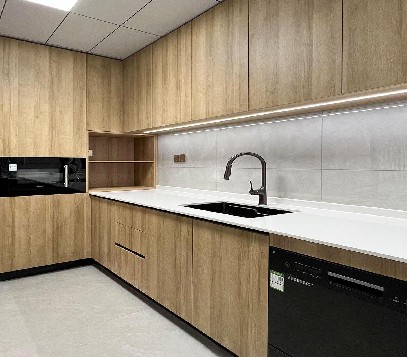
A kitchen cabinet order can use plywood for the sink base, MDF for painted doors, and melamine-faced particleboard for other cabinet boxes. Each material serves a different purpose. Problems arise when the purchase specification gives the entire kitchen one material name and leaves the supplier to interpret the rest.
For project cabinetry, choose plywood where the specified panel and construction suit demanding box, shelf, or fixing conditions. Consider MDF for smooth painted fronts and routed profiles. Consider melamine-faced particleboard for repeatable cabinet interiors in controlled conditions when the panel, joints, edges, and hardware suit the application. Compare the finished assembly, especially at sinks, exposed edges, and heavily used drawers.
Compare the three materials by cabinet component
| Material | Common project application | What to verify in a quote |
|---|---|---|
| Plywood | Box components, shelves, sink-base parts, or assemblies where the selected grade suits the fixing detail | Core and face grade, panel thickness, bonding or intended exposure, flatness, edge treatment, and finish on each face |
| Medium-density fiberboard (MDF) | Smooth painted fronts, routed profiles, and decorative panels | Panel grade, profile detail, edge preparation, face and back finish, fixing detail, and performance in the intended environment |
| Particleboard | Flat cabinet components, often with melamine-faced interiors | Panel grade, thickness, surface finish, edge banding, joint design, and compatibility with the selected fasteners and hardware |
Plywood uses bonded veneers. MDF uses wood fibers. Particleboard uses wood particles. Those descriptions identify the core. The purchase decision also depends on the exact panel, surface, edges, and construction. “Melamine,” for example, usually describes the decorative surface in a cabinet specification. Ask which substrate it covers and how the cut edges are finished. APA cabinetry panel guidance, Composite Panel Association technical resources
Where plywood earns its place
Plywood is worth pricing when the cabinet design puts meaningful demands on fixing points, shelving, or a box that will be handled repeatedly before installation. Ask for the grade and actual construction. Panels can differ in face quality, thickness consistency, core gaps, flatness, and bond characteristics. Compare the grade offered against the component’s job and the cabinet maker’s construction detail.
Consider an illustrative island with a long finished end panel and a cabinet supporting a countertop. The designer should check how the end panel is attached, where the load is transferred, and what happens at the exposed edges. Plywood can be a candidate if the specified panel and details work for that assembly. Verify the mounting and top support on the drawing even if the supplier describes the box as heavy-duty.
Where MDF fits
MDF’s relatively uniform surface and machinability make it a practical choice for many smooth painted and routed fronts. In a painted shaker-style or profiled door, review the route shape, the finish on the profile and back, and the treatment of machined edges. Those details affect appearance and exposure more directly than a broad description such as “painted MDF.”
Check door dimensions, weight, hinge type, and fixing method for tall or wide fronts. Get the hardware supplier’s guidance for the actual door configuration. Ask the cabinet supplier to demonstrate how a representative door sits and operates on the proposed box. Inspect the top and bottom edges as well as the face, because those areas are easy to overlook on a showroom sample.
Where particleboard makes sense
Melamine-faced particleboard can suit repeated cabinet interiors where a consistent surface and controlled cost are priorities. Specify the panel grade, surface and edge banding, then review cabinet joints and hardware fixings. Pay attention to exposed ends and penetrations near water or steam, including around a dishwasher.
A large project may gain more from a carefully specified and checked standard box than from an upgrade that leaves its hardware, back, and installation details vague. Compare the actual assemblies. Ask for the thickness and fixing method of the back and shelf supports, then verify how the finished cabinet will be secured and handled on site.
Treat water exposure as an assembly issue
The highest-risk area is often a joint or opening. Around a sink, review pipe penetrations, bottom corners, the exposed front edge, the back of the cabinet, and how the top meets the wall. A coated face protects only the area it covers. Water that enters through a cut edge or connection can affect the cabinet even when the visible surfaces look intact.
A moisture-resistant panel designation should be tied to a supplier data sheet and the applicable grade or test basis. Define the intended exposure and how the edges, joints, and field cuts will be protected. Give installers instructions for sealing any cut they are authorized to make. Provide access to valves and traps so a small leak can be detected and corrected.
Put upgrades where they solve a defined problem
Consider a specification for 80 rental apartments. The buyer wants a consistent painted finish and is concerned about wet-zone damage. One option to price is a plywood sink base with documented edge treatment, a compatible protective tray where feasible, and an accessible plumbing layout. The dry-zone interiors could use a specified melamine-faced panel. The painted fronts could use the same MDF construction throughout.
Ask the supplier to show the change in cost, material schedule, and installed details for that option. Compare it with a project-wide plywood box option using the same doors, hardware, packing, and delivery basis. A targeted upgrade is easier to judge when its purpose is explicit and the rest of the quote stays comparable.
Specify thickness, edges, and hardware together
A line such as “18 mm plywood cabinets” leaves several decisions open. Does the thickness refer to the sides only, or also to the bottom and shelves? What is the back made from? Which faces are finished? What edge treatment is included? A nominal thickness is one input. Shelf span, support, load, back attachment, and joint construction help determine whether the cabinet meets its intended use.
Write the schedule by component. Specify the material and grade, nominal thickness, visible and concealed faces, edge treatment, and any special details. For an adjustable shelf, show the clear span and support design and describe the expected loading. Ask for supporting data or a representative check when the shelf will carry heavy items. For hinges and slides, list the actual hardware model and how it will be fixed.
Use a representative sample when performance matters
An approved door sample can settle color and sheen. It leaves assembly questions open. For a repeated project order, request a representative box with the proposed sides, back, joints, hardware, and an actual door or drawer. Review the sample at the specified cabinet width and with the correct hardware configuration.
At a factory review, compare the edges with the specification, check operation and alignment, and inspect the fastener locations and accessible joints. If the project requires a load, moisture, or cycle test, agree on the test basis, specimen, conditions, and acceptance criteria before testing. Record results against that method. A hand-operated drawer and a good finish sample are useful checks with distinct purposes.
Check emissions documentation for the destination market
Material selection and emissions compliance are separate decisions. The destination, panel type, supply chain, and finished product determine what records may be needed. Ask the supplier to identify the offered panel producer and grade and show how production records connect the panels used to the order.
For U.S. imports, EPA’s TSCA Title VI rules cover specified composite wood products, including hardwood plywood, MDF, and particleboard, and can apply to finished goods containing regulated panels. Confirm the relevant certification, labeling, documentation, and import requirements with the responsible importer before placing the order. Review any other market or project-specific requirement separately. EPA composite wood stakeholder FAQs, EPA import requirements
If a supplier submits a generic certificate, ask which material and production source it covers. Compare the supporting records with the panel schedule and the product being ordered. Have the importer review the package early enough to resolve mismatches before shipment. Keep the approved evidence with the purchase and receiving records.
Compare the price of the kitchen you will receive
Ask for a base specification and a small number of alternatives with component-level differences. Keep the layout, door finish, and hardware fixed while comparing box materials. If another variable must change, list the difference explicitly. The price effect of a panel upgrade can be difficult to see when it is bundled with different hardware or packaging.
| Illustrative quote option | Components changed | Questions to ask |
|---|---|---|
| Base package | Specified melamine-faced panel for general boxes and painted MDF fronts | What panel grade, edge treatment, back construction, and hardware fixing are included? |
| Wet-zone upgrade | Sink-base construction and sealing detail | Which panels change, how are penetrations treated, and what is the cost per affected kitchen? |
| Wider plywood upgrade | Defined box sides, bottoms, or shelves | Which components retain the base specification, and what changes in packed weight, handling, or site work? |
Use the comparison to check spare-part strategy as well. A finish panel or door can be more disruptive to replace than a hidden shelf. Keep approved finish samples and records of part codes. When natural veneer is used, ask how variations will be judged across adjacent fronts and what can realistically be matched in future production.
Verify that the approved construction reaches the site
Turn the agreed material schedule into an inspection reference. Have the supplier confirm the order-specific panel and hardware identification before manufacture. At inspection, check representative parts against the approved sample, schedule, and drawings. Verify visible finish, edge workmanship, component dimensions, and hardware operation. Use suitable evidence to confirm hidden construction where visual inspection of a finished cabinet is insufficient.
Record carton or batch identifiers against inspected items so the buyer can trace a problem if one appears after delivery. Give the installer the handling and storage instructions, including any limits for site cuts or wet work. If damage is found at receiving, use the inspection photos and package records to decide whether it arose in production, transport, or site handling.
Frequently asked questions
Is plywood always the best material for kitchen cabinet boxes?
Plywood can be suitable when the panel grade, fixing requirements, and exposure justify it. A specified particleboard system can also suit a project’s dry interior cabinets. Compare the complete box, including joints, edges, back, support, and hardware.
Can I use MDF doors with plywood cabinet boxes?
Yes. It is practical to choose a smooth painted front independently from the box material. Confirm the door dimensions, weight, hinge selection, finish coverage, and fixing details for the actual cabinet.
Does melamine mean the cabinet is made of particleboard?
Melamine describes the surface in typical cabinet quotations. It can be applied to different engineered substrates. Ask the supplier to identify the core and grade, edge treatment, and finish on both faces as required.
Is moisture-resistant MDF suitable near a kitchen sink?
It can be considered for appropriate components when the documented panel grade and finished detail suit the exposure. Review how edges, penetrations, and joints are protected. Plan for accessible plumbing and prompt leak repair.
What is the best way to compare an upgrade to plywood?
Ask which components change and keep the rest of the quote consistent. Compare the specified grade, edges, joints, hardware, packed weight, and delivered scope. Decide whether the upgrade solves a particular concern, such as fixing, shelf support, or sink-base construction.
What should I request before approving a cabinet material?
Request the component schedule, panel and finish data, an approved edge and finish sample, and a representative assembly when the order warrants it. Confirm the destination documentation, inspection reference, and procedure for substitutions.
Conclusion
Choose the cabinet material at the component level. Start with exposure, fixing, finish, and maintenance needs. Then compare cost against a defined box, front, or shelf assembly. Once the material schedule is approved, use it for quoting, sample approval, factory inspection, and replacements. It gives every party a reference for what the material name means on this particular order.